

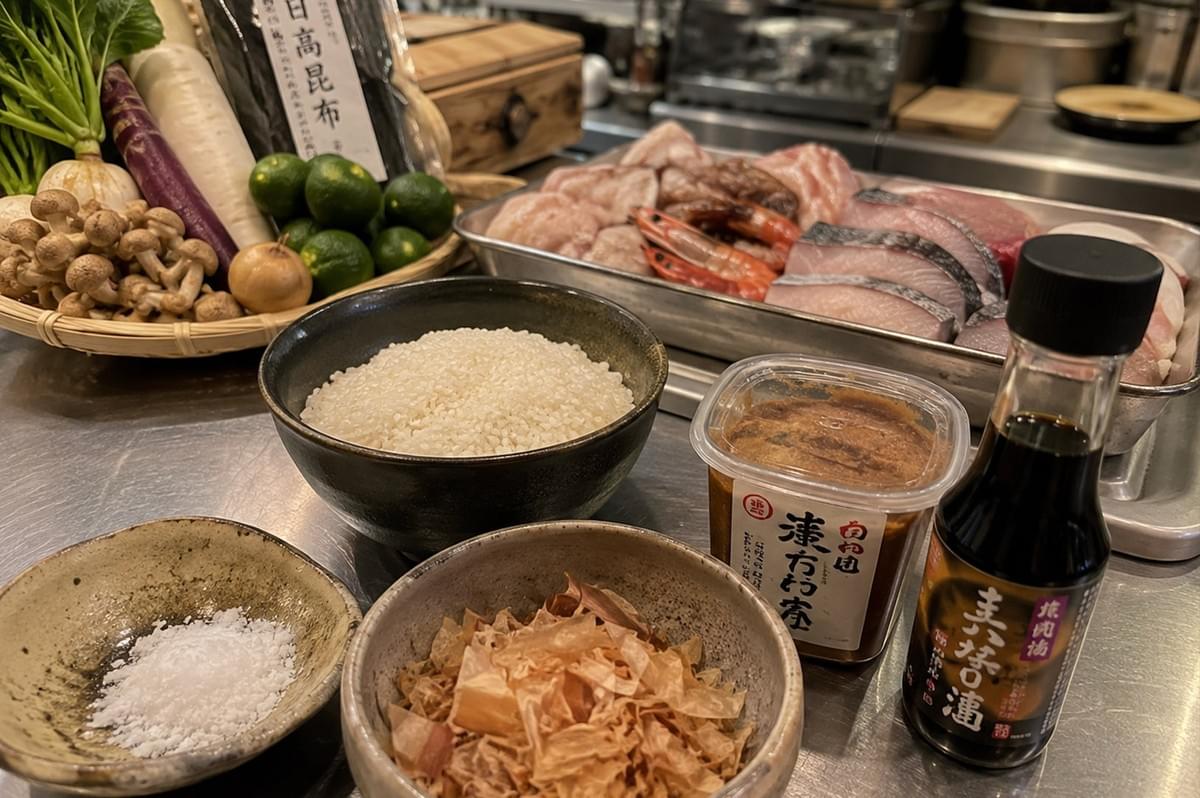
In every kitchen, there are moments when substitutions are practical. A different herb, a less expensive cut, or a simpler garnish can still produce something satisfying. But there are certain ingredients I will never treat casually. They form the foundation of flavour, and when the foundation is weak, technique can only hide the problem for so long.
The first is rice. In Japanese cooking, rice is not a background element. It carries aroma, temperature, texture, and memory. Whether I am preparing sushi rice, donburi, or a staff meal after service, I look for grains that cook evenly and hold their character. Rice must be washed carefully, rested properly, and served at the right moment. A beautiful topping cannot rescue rice that feels tired.
The second is dashi. Good dashi is quiet, but it changes everything around it. I use kombu and katsuobushi with attention to temperature and timing, because bitterness or muddiness can enter quickly. At home in Singapore, cooks may be tempted to rely entirely on instant stock. Convenience has its place, but making dashi from whole ingredients teaches you how umami should feel: clean, rounded, and never aggressive.
I also refuse to compromise on soy sauce and miso. These are living expressions of fermentation, not simply salty seasonings. Their aroma, depth, and finish vary greatly between producers. The Japanese Ministry of Agriculture, Forestry and Fisheries explains how traditional fermented seasonings such as soy sauce, miso, vinegar, and mirin shape Japanese food culture. I taste them before using them, then choose according to the dish rather than habit.
With seafood, freshness is only the beginning. A fish can be fresh and still be unsuitable for the preparation. I consider fat content, firmness, season, handling, and how the flavour will develop after resting. For omakase lovers, this is why two similar slices of fish can taste completely different. Quality depends on the chain of care from sea to supplier to cutting board.
The same principle applies to salt. Salt is often treated as invisible, yet it controls sweetness, bitterness, moisture, and texture. I keep different salts for seasoning, curing, and finishing. The goal is not to make food salty. The goal is to reveal what is already inside the ingredient.
Finally, I never compromise on seasonal produce. Singapore gives home cooks access to remarkable ingredients throughout the year, but availability is not the same as peak condition. I choose vegetables, citrus, mushrooms, and herbs by aroma and texture, not appearance alone. When an ingredient is truly ready, the chef’s job becomes simpler.
For home cooks, this does not mean buying the most expensive option. It means learning which details matter, asking better questions at the market, storing ingredients correctly, and allowing simplicity to expose both quality and care.
This is the discipline behind my cooking: buy less, observe more, and respect the ingredients that carry the dish. Luxury is not always uni, truffle, or wagyu. Sometimes it is properly cooked rice, clear dashi, or a piece of fish handled with patience.
That philosophy comes alive in Shirasu and Uni Cold Somen, where delicate noodles, cold dashi, whitebait, citrus, and uni depend completely on clarity and restraint. It is a bowl that proves the finest ingredients do not need noise. They need care.
