

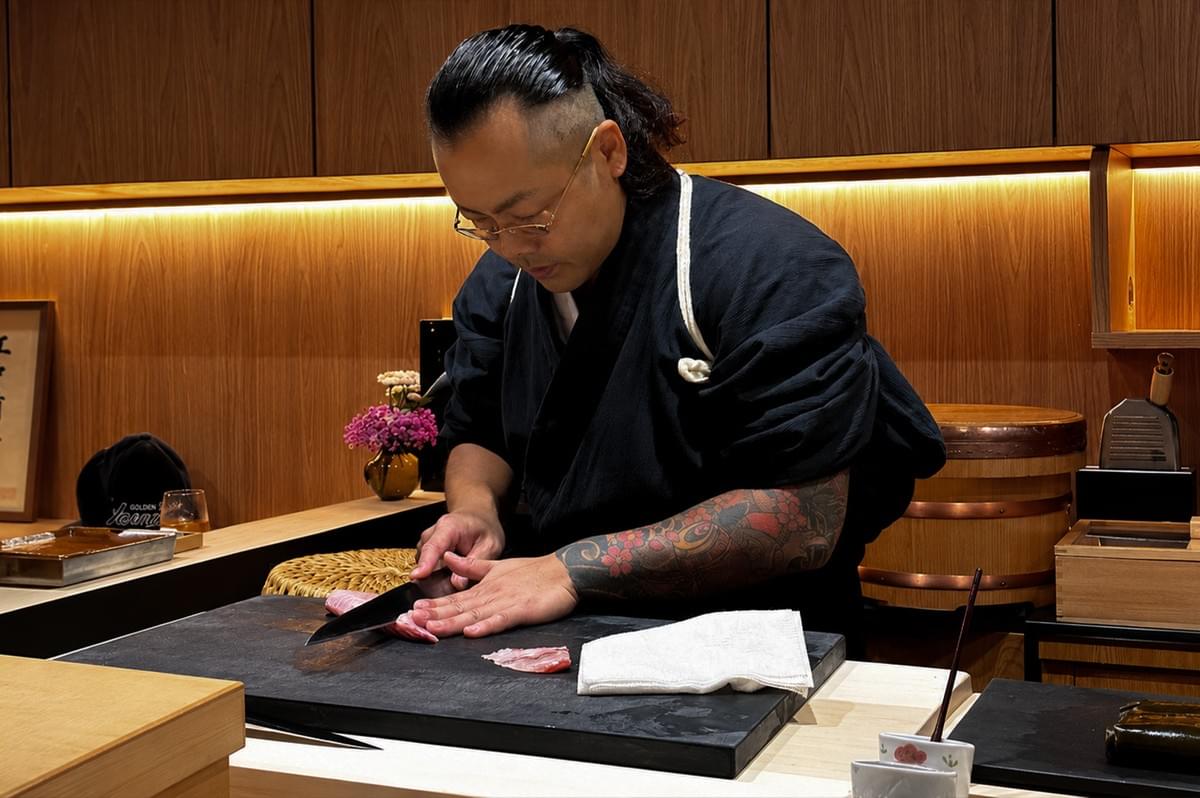
Walking into Chef Masa’s kitchen before service begins feels entirely different from entering it at night. There is no conversation yet. No rhythm of tickets. No quick movements between stations. Instead, there is silence interrupted only by subtle sounds most people would overlook: the sharpening of knives, the rinse of rice beneath cold water, the quiet hiss of kombu warming slowly inside a pot.
Chef Masa often says that the quality of service begins long before the first guest arrives. The morning is not simply preparation. It is calibration.
We watch him inspect fish in near silence, turning each cut slightly toward the light. Texture matters as much as appearance. Aroma matters as much as freshness. Every ingredient is evaluated not only for quality, but for mood. Some mornings require restraint. Others invite experimentation.
This philosophy extends beyond sushi itself. Even the staff meals carry this same intention. The bowls prepared after service often begin as quiet morning ideas that evolve throughout the day. A sauce adjusted slightly. A broth simplified. A garnish removed entirely.
There is a misconception that refinement comes from adding more. Chef Masa believes the opposite. He removes constantly. He edits relentlessly. “If an ingredient is not helping the dish speak clearly,” he tells us, “it should not be there.”
The discipline is invisible to most guests, yet it shapes everything they experience at the counter.
You can see this same philosophy reflected in dishes like Celestial Miso Cod, where restraint, timing, and balance become more important than complexity itself. Read more here.
