

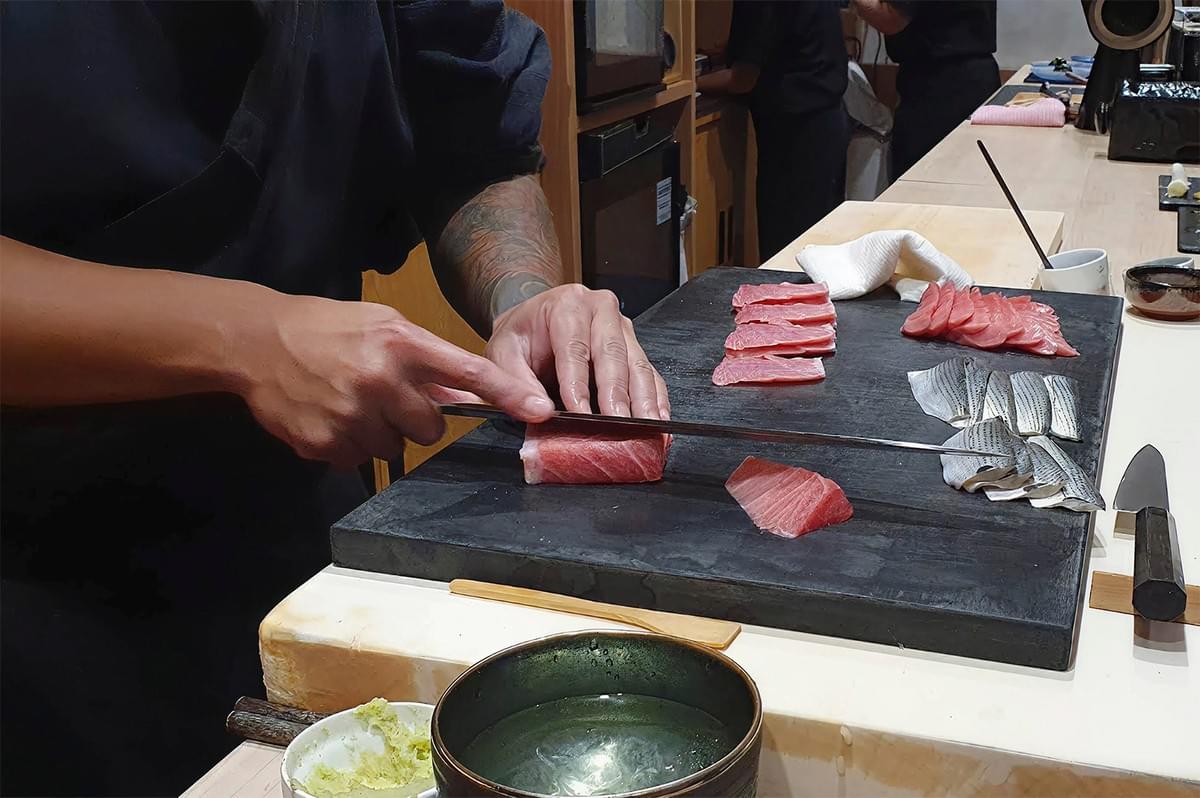
Walking into Chef Masa’s kitchen, I often find myself listening before I begin observing. There is a rhythm here that reveals itself slowly: the soft glide of a knife against the cutting board, the quiet simmer of broth in a small pot, the gentle rustle of parchment as ingredients are arranged with deliberate care. At first glance, everything appears calm, almost ordinary. But in the stillness of this kitchen, something deeper is always unfolding.
I once believed that great cooking could be understood through recipes alone. With reading SG DIning Guide, whenever I’ve gone to a restaurant, I know how much the technicalities matter in cooking. Measurements, temperatures, timing; the structured language of technique. Recipes promise certainty. Follow the steps, and the result should appear. Yet the longer I spend watching Chef Masa work, the more I realize that the most important parts of cooking resist being written down.
Some lessons simply cannot be captured in instructions.
They reveal themselves in moments.
One evening, I watched Chef Masa stand quietly in front of a tray of fresh fish. Service had already begun, and the kitchen moved with its usual quiet efficiency. But he paused longer than usual, studying each fillet under the light. The sheen of the flesh, the subtle marbling beneath the surface, the way the texture responded to a gentle touch. No one spoke. Finally, he selected a single piece and nodded almost imperceptibly, as if the decision had been made somewhere long before the knife ever touched the board.
Later, I asked him what guided that choice.
He smiled softly. “Ingredients speak,” he said. “You only need to listen.”
The words sounded simple, but they carried a depth that no recipe could ever explain. Recipes can tell us how long to marinate a fish or how to balance miso with mirin. They can guide our hands through technique. But they cannot teach the quiet moment when instinct says the seasoning is just right. They cannot describe the subtle shift in aroma that signals a sauce has reached its perfect point.
Chef Masa never rushes those moments. He approaches ingredients with patience, studying them the way one might study an old photograph. Each gesture feels deliberate. Each movement of the knife reveals an understanding that comes from years of attention.
Watching him work reminds me that cooking is not simply a sequence of steps.
It is a conversation.
The fish offers its texture. The seasoning responds. Heat transforms everything in between. In our kitchen, we often speak about restraint, not because simplicity is easy, but because it demands the deepest understanding. Every element on the plate must have purpose. Nothing is added merely for decoration.
Chef Masa often says, “The best dish is the one where nothing more can be removed.”
During service, that philosophy becomes visible. When a finished plate is placed on the counter, there is always a brief moment of silence. Not the silence of uncertainty, but the quiet recognition that something has reached its natural balance.
And yet the recipe that produced it will never fully explain why.
Because the real lesson was never in the measurements.
It was in the observation. The patience. The willingness to pause and notice the details others overlook. Standing in Chef Masa’s kitchen has taught me that mastery is not about memorizing instructions. It is about learning to see.
These are the lessons that remain long after the last plate leaves the counter.
The ones no recipe can ever truly capture.
If this reflection speaks to you, you may also enjoy Celestial Miso Cod, a dish that embodies Chef Masa’s philosophy of restraint and balance.
